
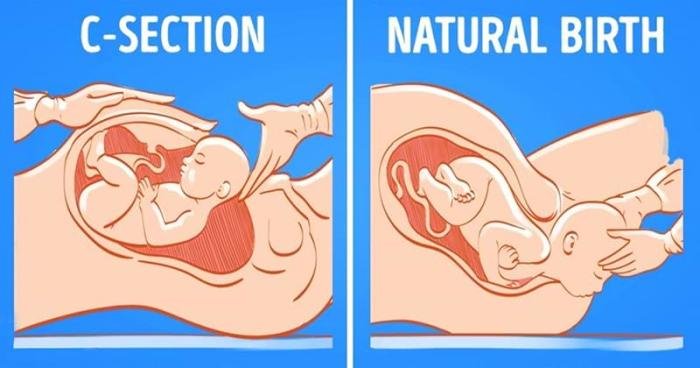
The choice of how to have a baby is among the major choices for parents who are expecting. A lot of mothers are confused about normal delivery vs C-section, which one is the best? Many mothers hope for a Normal delivery (vaginal birth); however, some may require a Cesarean C-section (C-section) because of medical issues. Both are safe provided they are supervised by a trained medical professional, but it's helpful to know which one is better and what benefits they offer, as well as when each is required. It is dependent on the mother's health condition, the baby's condition, as well as the medical advice of the doctor to ensure safety for the mother and baby.
What Is Normal Delivery (Vaginal Birth)?
A normal delivery happens when the baby comes out naturally through the birth canal. It is usually preferred when the pregnancy is healthy and there are no complications.
How It Happens:
Normal delivery has three stages:
- Labor: The uterus contracts, and the cervix slowly opens.
- Pushing: The mother pushes the baby through the cervix and vagina.
- Placenta Delivery: The placenta comes out shortly after the baby.
Important Points:
- Faster Recovery: Most mothers go home in 1–2 days and recover within a few weeks.
- Benefits for Baby: Passing through the birth canal exposes the baby to healthy bacteria, which helps build immunity. The baby’s chest is also gently squeezed, helping remove extra fluid from the lungs.
- Pain: Labor pain can be intense, but options like epidurals help manage it.
What Is a C-Section (Cesarean Delivery)?
A C-section is a surgery where the doctor makes an incision in the mother’s abdomen and uterus to safely deliver the baby. It can be planned or done in an emergency.
How It Happens:
- Anaesthesia: Usually, a spinal or epidural is given so the mother is awake but pain-free.
- Incision: A horizontal cut is made on the lower abdomen.
- Delivery: The baby is gently taken out through the incision.
- Closing: The doctor closes the uterus and skin using stitches or staples.
Important Points:
- Longer Recovery: Hospital stay is usually 3–4 days, and full recovery may take 6–8 weeks.
- Predictable Timing: Planned C-sections allow choosing a date.
- Pain: No pain during surgery, but pain and discomfort are common after the operation.
Normal Delivery vs. C-Section: Quick Comparison
|
Feature |
Normal Delivery |
C-Section |
|
Method |
Natural birth through the vagina |
Surgical birth through abdomen & uterus |
|
Duration |
Labor can take many hours |
Surgery takes 30–60 minutes |
|
Recovery |
Faster (few weeks) |
Slower (6–8 weeks) |
|
Hospital Stay |
1–2 days |
3–4 days |
|
Pain |
Labor pain, easier recovery |
No pain during surgery, more pain after |
|
Risks |
Tearing, pelvic floor issues |
Infection, blood loss, blood clots, future pregnancy risks |
FAQs: normal delivery vs C-section
1. Which one of the delivery methods is safest?
The majority of pregnancies are healthy, and the normal birth is thought to be more secure due to fewer chances of complications and is faster to recover. If complications do arise, such as the breech or fetal distress--a C-section can be the best alternative. The physician will direct you depending on the condition of your baby.
2. Should I consider a C-section if there is no medical issue?
Yes, they are permitted at a number of hospitals. Doctors will, however, discuss the potential risk, like the more time to recover and surgical complications. In the absence of a medical reason, a vaginal birth is generally suggested.
3. What is the best way to have a normal birth after having a C-section (VBAC)?
Many women can be blessed with a VBAC (Vaginal Birth Following Cesarean). The type of incision used will determine the kind of surgery performed earlier, as well as whether the pregnancy is currently in good health. Your physician will confirm whether VBAC is suitable for you.
4. What are the potential risks associated with C-sections during future pregnancy?
- A number of C-sections can slightly raise the risk of:
- Placenta Previa (placenta protects the cervix)
- Placenta Accreta (placenta grows too deeply)
- Uterine Rupture (rare but serious)
5. How does the method of delivery affect the bonding process or breastfeeding?
No. The bonding process and breastfeeding rely on support and care, not whether birth took place vaginally or by a surgical procedure. Hospitals can help mothers establish skin-to-skin contact and start breastfeeding as soon as they give birth, no matter the birth method.
6. Normal delivery or C-section? Which one is superior?
The normal delivery method is usually thought of as superior because it is more efficient in recovering, and the chance of developing complications is reduced, and it's easier for the mother and child.
But, C-sections are preferred in cases of medical necessity, including problems, high-risk pregnancy or if doctors advise it to ensure the safety of the mother and baby.
The best choice is always dependent on your health and your physician's recommendations.